The FIFA World Cup 2026™ is the biggest edition in history, featuring 48 teams competing across Canada, Mexico, and the United States. To manage this massive scale and protect player safety, FIFA has established several updated and streamlined rules.
This guide breaks down the essential rules governing the tournament—from the mandatory hydration breaks to the updated tiebreakers and VAR protocols.
1. Group Stage Tiebreakers: Deciding Who Moves On
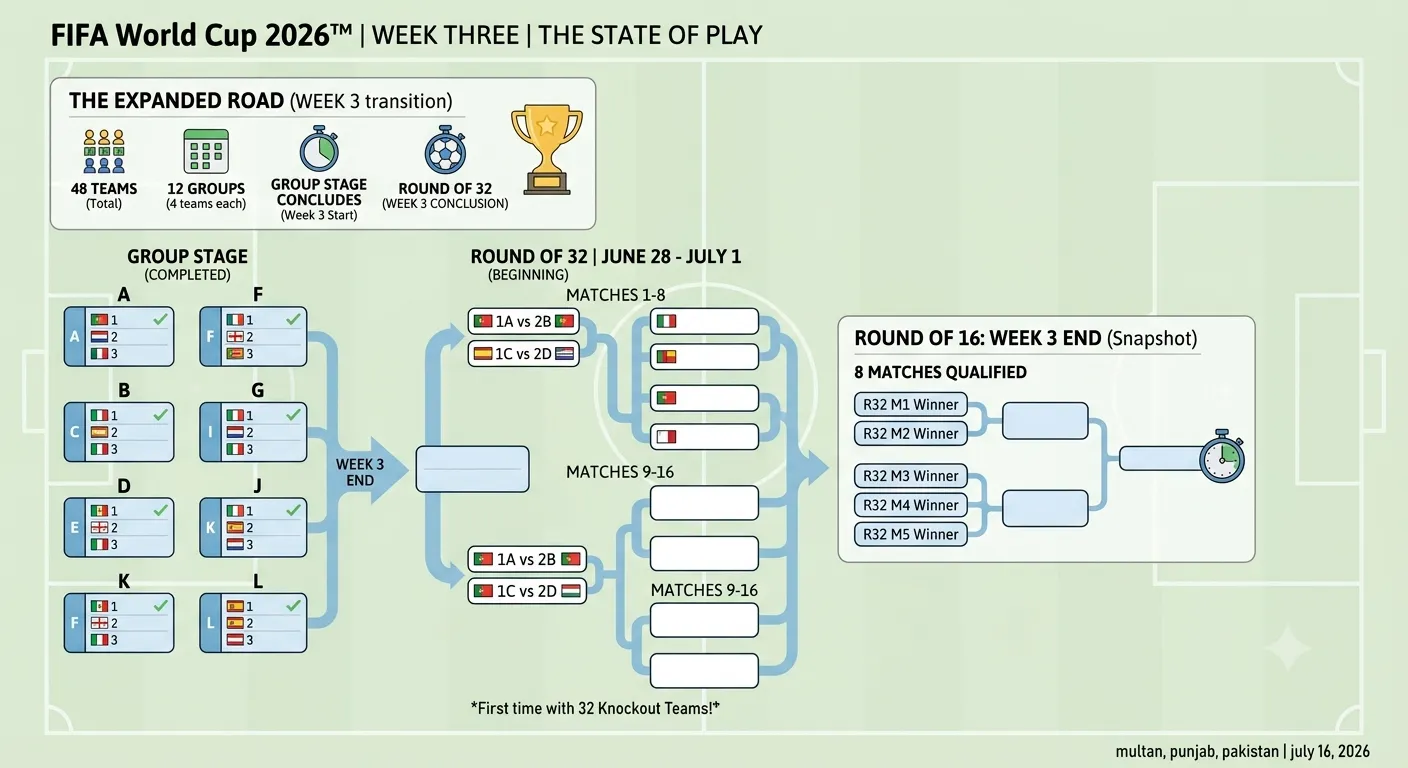
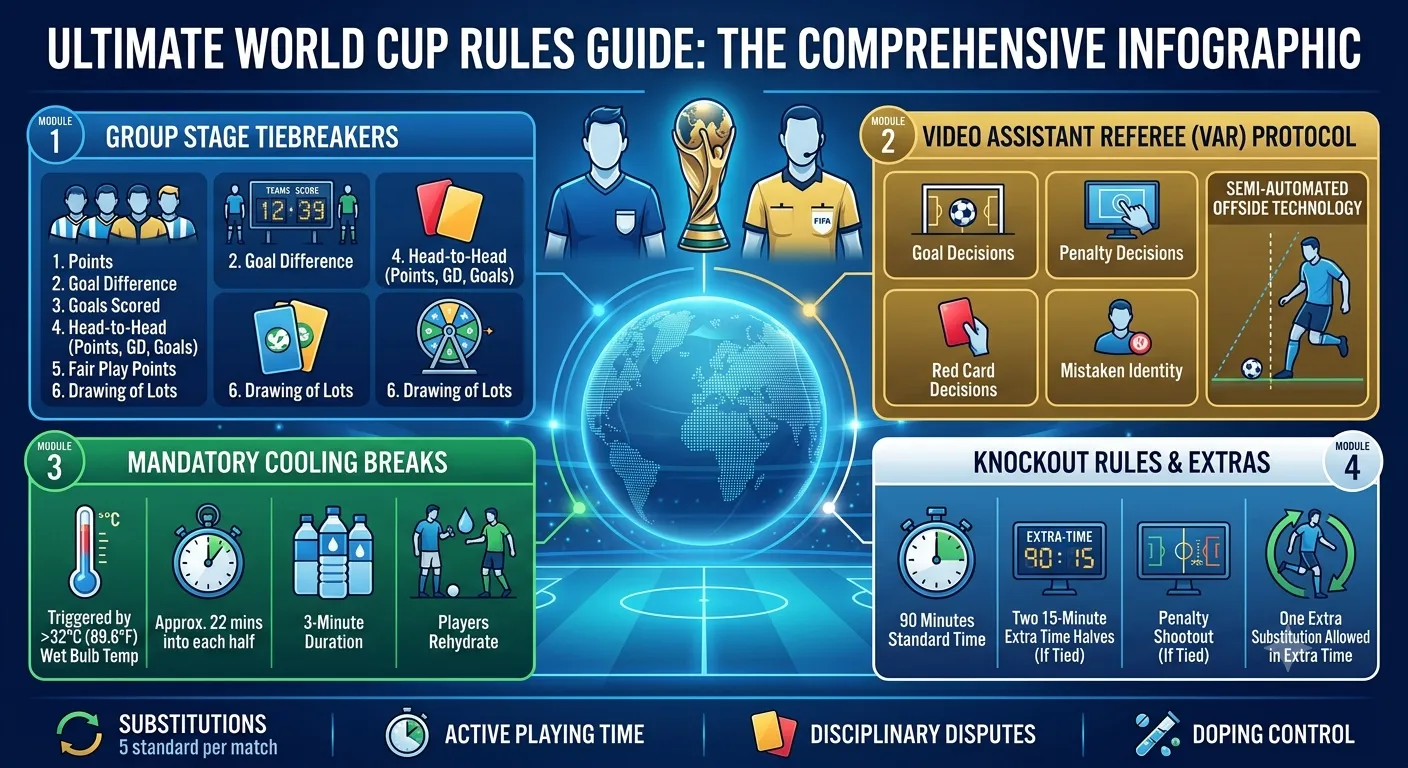
With 12 groups of four teams, the stakes to qualify for the new Round of 32 are higher than ever. If teams finish the group stage tied on points, FIFA uses a strict, sequential set of tiebreakers to separate them:
- Goal Difference: The primary tiebreaker is the superior goal difference (goals scored minus goals conceded) across all group matches.
- Goals Scored: If still tied, the team with the most total goals scored in all group matches ranks higher.
- Head-to-Head Points: Points obtained in the group matches played strictly between the tied teams.
- Head-to-Head Goal Difference: Goal difference resulting only from the matches between the tied teams.
- Head-to-Head Goals Scored: Most goals scored in matches between the tied teams.
- Fair Play Points: Conduct on the field is calculated by deducting points for disciplinary cards:
- Yellow card: –1 point
- Indirect red card (second yellow): –3 points
- Direct red card: –4 points
- Yellow card and direct red card: –5 points
- Drawing of Lots: If teams remain completely inseparable across all previous metrics, FIFA will resort to drawing lots to determine who advances.
2. Mandatory Hydration Breaks: A Major 2026 Shift
One of the most talked-about updates for 2026 is the mandatory hydration break policy. In previous World Cups, referee-led “cooling breaks” were only triggered if the environmental Wet Bulb Globe Temperature (WBGT) exceeded 32°C (89.6°F).
Under the new regulations, every single match will feature two mandatory three-minute hydration breaks, regardless of the stadium’s climate control, weather, or geographic location.
- Timing: The referee stops play precisely 22 minutes into each half. If an active injury or stoppage is ongoing around the 20th or 21st minute, the referee has the flexibility to adjust the timing slightly.
- Duration: Exactly three minutes from “whistle to whistle,” ensuring players have ample time to rehydrate and coaches can offer brief tactical adjustments.
3. Video Assistant Referee (VAR) and Offside Technology
VAR continues to play a vital role in ensuring fair play, focusing strictly on four “match-changing” scenarios:
- Goals/No Goals: Checking for fouls, offsides, or ball-out-of-play in the buildup.
- Penalty Decisions: Awarding or rescinding spot-kicks.
- Direct Red Cards: Checking for serious foul play or violent conduct.
- Mistaken Identity: Ensuring the correct player receives a yellow or red card.
For offside decisions, Semi-Automated Offside Technology (SAOT) uses dedicated tracking cameras and a sensor embedded inside the match ball to determine offsides in seconds, generating 3D visualizations for referee reviews.
4. Stoppage Time and Substitutions
Following the precedent of recent FIFA tournaments, referees are instructed to rigorously calculate and add lost time back at the end of each half. Time lost to goal celebrations, substitutions, VAR checks, injuries, and the new hydration breaks is calculated precisely, leading to more accurate “active playing time”.
Teams are permitted five standard substitutions per match, allowed across three separate windows (excluding halftime). If a match goes into extra time during the knockout rounds, teams are granted one additional sixth substitution and an extra substitution window.